Friday, October 11, 2013

The Race to the sea

From the ebook World War 1 - An Unkept Promise

October 13th

I went with two Sections of guns to position on BEAULINE RIDGE. We arrived about midnight, [it was] pitch dark and heavy going. [We] could not use lights or even smoke, owing to close proximity of enemy. We got into position without mishap, at dawn next morning; it was a sight almost indescribable, [for] one could not walk for three yards unless he was in a great shell hole.

A small bank about 10 foot high was the only shelter and the guns and wagons were well dug into this.
We had trenches dug by the side – the guns we relieved must have had a terrible time – this place was called by us “Pepper Hill” and the infantry called it “The Devil’s Own”.

Collins and I worked like niggers and dug a small cavity under the bank and felt quite at home, we were in fact like rabbits when not firing.

We remained in this position until the night of the 16th, while leaving, a terrific night attack was in progress – we were relieved by the French.

 [We] marched all night [and] rested for a few hours next morning, and [then] marched to NEUILLY-ST-FRONT. [We] entrained, for unknown destination, what a great relief it seemed, to be away from the ceaseless sound of battle. [i]

While the Battle of The Aisne continued, Germany had assembled an army further north, which was heading towards the lower River Somme, between Amiens and Abbeville.
The BEF was now six divisions strong so Sir John and Joffre agreed that the British II Corps should be rapidly repositioned to Abbeville.
While the British repositioned themselves, the French attempted to attack the German’s western-flank. [ii]
The enemy was trying to accomplish the same, thus producing a leapfrog effect which continued in a westerly direction. Later it became known as the” Race to the Sea”.
Winston Churchill pulled General Haig’s 1st Corps and transferred them from Aisne via rail to Hazebrouck, where they started their march north towards Cassel and the cities north of Ypres. [iii]
  
Fred wrote:

October 17th and 18th

Travelled by train through AMEINS, [sic] BOULOGNE and CALAIS, detraining at HAZEBROUCK – 25 miles from the Belgian boarder, where we bivouacked [for the night, before marching to CASSEL[iv]


[i] Ibid

[ii] Marshall, S.L.A., World War 1 p 129

[iii] Marshall, S.L.A., World War 1 p 129

[iv] Coxen, Fred G.

Thursday, October 10, 2013

Capt Fred Coxen's Military Career (last posting)


Referring back to his service record, Fred remained in France until May 18, 1918, at which time he returned to England.
   A military record discloses that in November of 1918 he was seconded for service with the newly-formed Royal Air Force[1], and assigned to the 253 Squadron, RAF Bembridge. He is listed as an Observer Officer, placed in charge of the payroll department. I have no doubt that Fred was sent to the RAF because of his prior payroll experience while Adjutant of the Mersey Defence District.
   While searching through the box of documents I uncovered a communiqué from Captain D. Dustin, Officer Commanding 74th Wing, RAF Calshot. In the letter he recommended Fred for a promotion to the temporary rank of Lieutenant. A further search produced a memo affirming that Fred was promoted to the permanent rank of Lieutenant – retroactive to July 1, 1917.
 During the period Fred operated the payroll department for the RAF, the RFA sent a message requesting his return to his RFA unit forthwith. Within the same communiqué, the RAF requested he remain with them for an additional two weeks, reasoning that with a heavy work load and complicated payroll system, his skill level was required until a replacement could be trained. (Figure 14)[2] Therefore on August 7, 1919, the Officer Commanding, RAF Navigation School, Calshot, drafted a letter cancelling Fred’s orders to report to his RFA unit. (Figure 15)[3]
I speculated as to whether he learned to fly during the time spent with the RAF. I found nothing within his records indicating he received flight training; however, I have a photograph showing Fred in an aviator’s suit. [i] 
 I posted the photo on the “Great War Forum” website; a member identified the suit as a standard RAF issue Sitcom Suit, made from proofed khaki twill, which was rubberized and lined with mohair. (Figure 16) [4]
 It is indisputable that while serving with the RAF, Fred wore an officer’s uniform with an Observer’s Half Wing, located above the left top pocket of his uniform jacket. His uniform would be congruent with his Navigator’s training, and gave credence to the fact that he had an aviator’s flight suit. Nevertheless, this latest discovery contradicts our personal family lore, and ruins a good story. (Figure 17)[5]
Prior to my in-depth research, it was believed that a cherished, wooden picture frame, containing photographs of both Fred and his wife, was likely crafted from the remains of a WWI aeroplane propeller. However, a further assumption was made that the propeller came from an aircraft flown by Fred, which now appears to be false.
Discovered among his personal items was a photograph of a Short 184 seaplane serial number N9111. It is unknown if Fred flew or was a navigator on this type of aircraft; yet whatever the case, it is an interesting photograph. (Figure 18)[6]
Fred's official military record shows that he transferred back to the Regular Army Reserve of Officers as Captain, on the 26th of February, 1920, at which time he left the service and returned to his civilian occupation of electrician.
The exact reason he ended his journal on May 6th, 1915 will remain unknown.


[1] Originally British aero-squadrons were named the Royal Flying Corps, but in 1918 the RFC amalgamated with the Royal Naval Air Service and changed to the Royal Air Force.
[2] Document requesting RFA give extension to Fred remaining with RAF
[3] Document cancelling RFA order for Fred to report back to duty with RFA
[4] Photo of Fred in flight uniform
[5] Photograph of Fred in RAF uniform with half-wing above left breast pocket
[6] Photograph of a Short 184 seaplane


[i] Ibid


Letter cancelling the RFA (orders by the RAF) for Fred to return to the RFA


Request from RAF that Fred stay an additional two weeks


Fred in his RAF flying suit


Fred in his RAF uniform - notice half-wing above left pocket - indicating he was  an observer


 A picture of a N9111 Short Seaplane

Wednesday, October 9, 2013

Capt Fred Coxen's Military Career 2

 The communiqué is divided into four sections; the first section is the original request from Colonel S.W. Lane, while the second section is a response from Headquarters Western Command, by Harry Cooper, Colonel Commanding No.3 District, referencing telegram 2259 G of 10.5.16, regarding speedy reply to the original request. In section three, marked “Confidential”, is directed to Garrison Commander, Mersey Garrison, Liverpool, referencing an attached letter dated 7th June, 1916, from Officer Commanding No.3 District – “Please say if Lieutenant F Coxen can now be returned to his unit, C.S. Hope – Johnstone, Major, General Staff, Western Command.” Section four is a return response, as follows
 If the establishment submitted in this office number as above of June 1916, your C.R.W.C.54318/37 (G).K.1045g of May 27th 1916 is authorized it is desired to recommend 2/Lieut. F. Coxen for the appointment of Adjutant and Quartermaster with the temporary rank of Captain.  2) He is now well acquainted with the details of the Liverpool A.A. Command, and it would be a pity to replace him by another officer who would have to learn the work all over again. (sd) R.F. Edwards, Brigadier-General, Commanding Mersey Defences; Liverpool, 9-6-16. [i]
Fred remained with the Defense District until November 30, 1916, at which time he returned to the RFA. 
I discovered a great deal of military correspondence regarding Fred’s request for additional duty pay, for the period he held the temporary rank of Captain. His claim was eventually settled, as stated in the letter written by the major commanding Liverpool A. A. Defences. (Figure 12)[1] The communiqué also presented insight to Fred’s next assignment,
 Captain Coxen was recommended for the appointment to Adjutant in May last, and carried out the duties whilst the Establishment was under consideration and issued, and until relieved, 30th November 1916, on assuming command of the 47th A.A. Company, R.G.A. There is a document signed by Fred with the 47th AA stamp located near the top of the document. 


I discovered a great deal of military correspondence regarding Fred’s request for additional duty pay, for the period he held the temporary rank of Captain. His claim was eventually settled, as stated in the letter written by the major commanding Liverpool A. A. Defences. (Figure 12)[1] The communiqué also presented insight to Fred’s next assignment,
 Captain Coxen was recommended for the appointment to Adjutant in May last, and carried out the duties whilst the Establishment was under consideration and issued, and until relieved, 30th November 1916, on assuming command of the 47th A.A. Company, R.G.A. A document was found which was signed by Fred with the 47th stamp so he was given command of the A.A. battery

Referring back to his service record, I noticed that he remained in England until November 11, 1917. Then on November 28, 1917, he was redeployed to France and assigned to an AA Battery. Prior to his departure, Fred posed for a photograph wearing his captain’s uniform, which was a temporary rank while serving with the Mersey Defence District. When Fred was transferred to an AA Battery in France he lost his temporary rank and reverted back to his permanent rank of 2nd Lieutenant.
Rummaging through the box of documents, I noticed a small piece of brown paper with a handwritten message. In the upper left-hand corner, the paper was stamped; “N ANTI-AIRCRAFT BATTERY” and directly below it was Fred’s signature “F Coxen RFA” “N” Battery.
The handwritten message congratulated Fred for the downing of a bird (aeroplane), however headquarters could not verify if the craft was downed solely by N-battery, or a section of Q-battery, so they divided the kill between the two batteries. Fred’s Battery was part of the HQ, 3rd Army group, which according to sources on the “Great War Forum,” was assigned to defend Paris. (Figure 13)[2] The fact that the paper was a congratulatory note from headquarters, and sent to Fred, indicates that Fred was “N” Battery’s commander. [i] 


[1] Letter written by Fred showing he did command the 47th AA in 1917
[2] Paper regarding shooting down enemy aircraft


[i] Ibid


Note giving Fred's AA battery partial credit for downing a German airplane


[1] Letter written by Fred showing he did command the 47th AA in 1917


[i] Coxen, Fred G. military documents


Monday, October 7, 2013

Capt Fred Coxen's Military Career (continued 1)

The last journal entry was on May 6th, 1915. I wondered what occurred to alter Fred’s routine of recording his daily experiences; perhaps the answer might be among his numerous military documents. They may contain bits of information necessary for reassembling the century old puzzle.
 After May 6th, the first recorded event impacting Fred was his field promotion to 2nd Lieutenant, which took place on August 21st, 1915. Although significant, it does not reveal what happened during the three months between his last entry and his promotion; questions without answers remain. 
 Within the box of documents, I found and opened Fred’s “Officer’s Record of Services – Army book 439”. Studying its contents, I found a notation on the pages titled, “Service”, stating he left France on September 1, 1915 and returned to England.  Under the column marked “At Home”, he had written, (AA[1] Drilling), September 2, 1915 to November 27, 1917. (Figure 10)[2]  This notation disclosed complexities within his simple statement “AA drilling”, which were previously undiscerned. Reviewing other military communiqués, I discovered that the Royal Field Artillery sent Fred to the Mersey Defence District on May 13, 1916. He was to perform inspections on the Anti-Aircraft Gun Detachments in Liverpool. (Figure 11[3])


[1] AA: stands for anti-aircraft
[2] British Officer Record of Service book
[3] Official document regarding Fred inspecting AA gun in Mersey Defense


Officer's Record of Services - Army book 439


Mersey Defence District AA gun detachments in Liverpool

World War 1 - An Unkept Promise

Sunday, October 6, 2013

Military Career of Capt Fred G Coxen

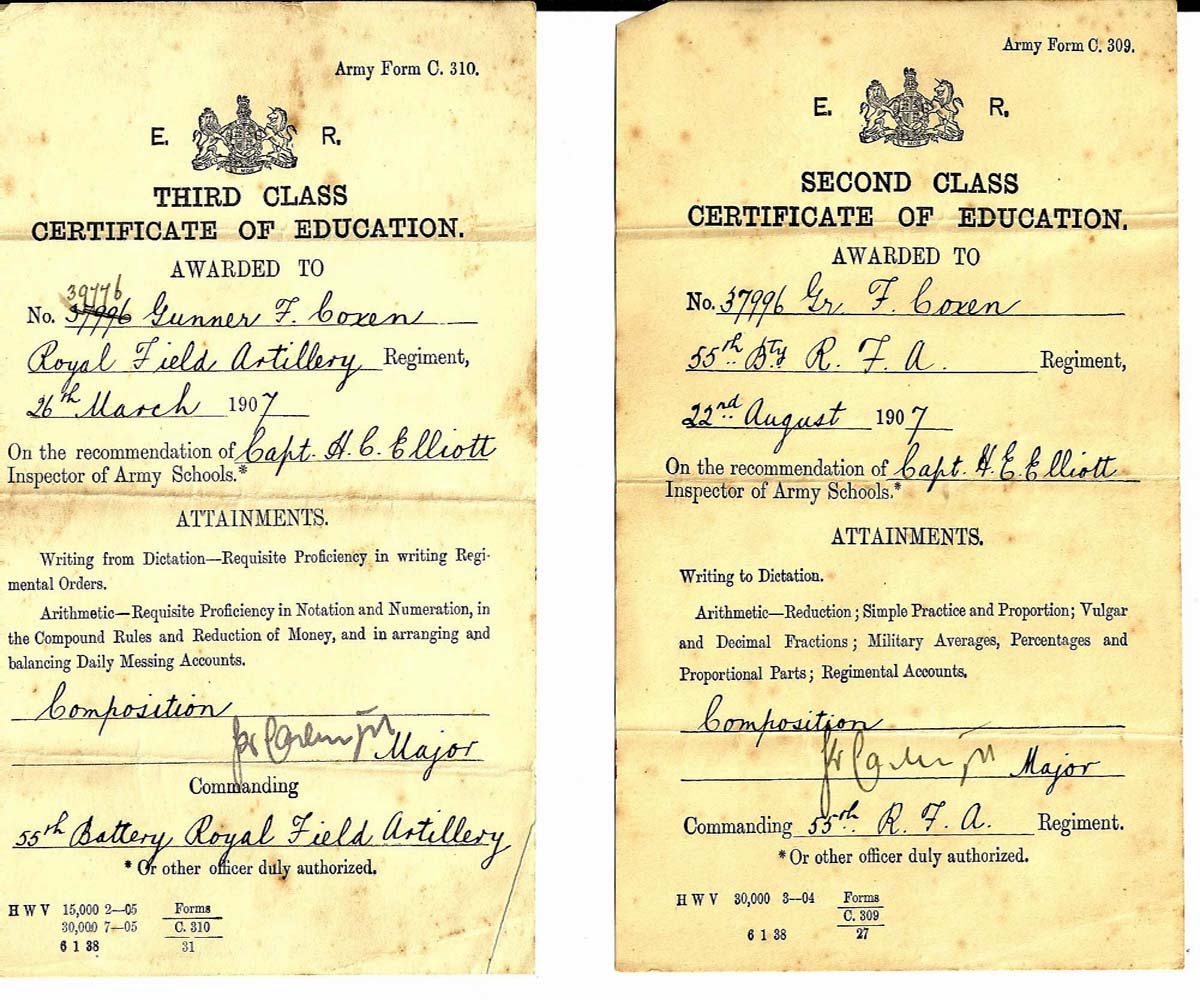
In 1905 at the age of 18 he joined the RFA and assigned to the 55th battery. By 1907 he received his second and third class education certificates in composition.


My grandfather is the one kneeling in the 1909 picture taken during telephone training. When the picture was taken he held the rank of bombardier and was a signaller.

MORE INFORMATION IS AVAILABLE IN World War 1 - An Unkept Promise

After serving for six years he left active service in 1911 and started his six year commitment in the RFA reserves and in that same year he earned his "Assistant Instructor's Certificate of Signalling"

Friday, October 4, 2013

Introduction - World War 1 - An Unkept Promise


The date was 1887. Richard and Alice Coxen were adding a son, Frederick George, to the four children that already filled their house. Living in Battersea, Richard was a sail-maker whose trade was vanishing due to Britain’s Industrial Revolution. (Figure 3) The modern vessels were propelled by coal-fired steam engines that bellowed out dark black smoke.

Little is known about Fred’s childhood, until he turned eighteen in 1905. That is when he enlisted in the Royal Field Artillery (RFA), assigned to the 55th Battery. His reasons for enlisting are unknown, but it could be argued that he did so in order to further his education. Even though the law of 1870 provided schooling for all children, it was common that children of working class parents were given only a rudimentary education at best; many never had an opportunity to attend school beyond the age of 12. 

When children turned the age of eighteen, the British military offered soldiers a basic education in return for six years of active and six years of reserve duty. In 1907 Fred earned both his third and second class education certificates in composition (figure 4) – leading one to believe that his desire to obtain an education may have been a major inducement in his decision to enlist. 
Along with a classroom education, he was also trained in all aspects of operating artillery, yet he selected Signalling as his specialty. When new field telephones were introduced, Fred was sent to Ireland in 1909 for training (Figure 5). Communications between the artillery batteries and the forward observation post were extremely vital for shelling accuracy and target selection. 

In 1911 he was awarded the “Assistant Signal Instructor” certificate, just prior to his departure from active duty to begin his RFA reserve obligation. (Figure6)  Serving in the RFA Reserves allowed Fred more time to pursue his training as an electrician. During this period of time he lived in Westminster, at 28 Berkley Street, an address which proved to be romantically significant. The attractive Lillian Turner, who lived with her parents at 32 Berkley Street, provided an alluring and convenient dating arrangement. It did not take long for Lillian to put a twinkle in Fred’s eyes. After a brief courtship, they were married on October 12th, 1912, at the Parish Church, in the Parish of St. Mary, Lambeth (Figure 7). By 1913 the young couple moved to 93 Rectory Lane, Tooting Bec Common, where Lillian gave birth to a baby girl they named Doris.  It could be assumed that Fred would have kept abreast of what was happening in Europe, after years of escalating turmoil. Rising political strife between Germany, France, and Russia, fueled by the escalating tensions between Austria– Hungary and Serbia produced whispers of war. 
Otto von Bismarck, a German ambassador, predicted that “some damn foolish thing in the Balkans,” would ignite the next war.  On June 28, 1914, the assassination of the Austrian heir apparent, Archduke Franz Ferdinand, by Serbian nationals, brought his prediction to fruition. The house of cards, constructed of alliances between key countries in Europe, was beginning to collapse. 

This descent into the abyss of war resembled the tumbling of a row of dominoes, when one falls the rest will follow. 
This chain reaction commenced when Austria–Hungary attacked Serbia in response to the assassination of the Archduke. Russia had an alliance with Serbia; therefore Russia declared war on Austria-Hungary. As Austria-Hungary had a partnership with Germany, Germany declared war on both Serbia and Russia. Russia and France had an agreement, so France slid into the abyss alongside the others. This cascading effect would continue as other countries entered the war, with the exception of Britain.  

Britain was not involved in alliances with other countries; however she did have a loose agreement with France, although not politically binding. It was an agreement that they would openly discuss providing mutual aid should either country be attacked. However, under the existing circumstances, this agreement took on deeper meaning and greater importance to Britain once she considered the consequences if France should lose the war. Parliament was debating this issue when the game changed. 
Germany declared that they were going to use Belgium, a neutral country, as an avenue for attacking France. This outraged Britain since she had strong ties with Belgium. Britain sent an ultimatum; if Germany invaded Belgium, Britain would enter the war.  

Germany’s Kaiser Wilhelm was unconcerned by the threat, and ordered his army to invade Belgium on August 4, 1914. When the German Army crossed over the Belgian border, the British Parliament signed the General Mobilization Decree; Britain was officially at war with Germany.

Within a few hours after the decree was posted, Fred received his orders to report for duty on August 5th at Newcastle upon the Tyne. The forces that had been put in motion prior to this date would forever alter Fred’s life.

Fred’s first journal entry:
August 4th 

“General Mobilization, will it be declared?” was the thought with me all day. My dear wife first gave me the news, but then I could not believe it, until we walked to the post office and saw the Official Declaration. 

And then I knew that, I should have to leave my home and dear ones — for “Where?” that was my one great thought. And until then I never realized what it all meant; with the conflicting thoughts of my dear ones, and the fascination that I was going to participate in a real scrap. My mind was in a real whirl, and was so until I left home next day, for Newcastle-on-Tyne.  And then — “Where?” 


August 5th 

I do not dwell on the thought of leaving my dear little wife, my mother, and baby — the journey up north was one of  
enthusiasm, for the train was packed with reservists, rejoining the Colours, as I, and all, seemed absolutely mad to go and obliterate Germany! 


August 6–7th

Drawing kit, passing Doctors, etc: - was detailed to join the 39th Bde R.F.A Surplus Details, as acting Q. M Sergt, at Borden Camp, [I] was very disappointed, for this meant that I should not go to the front yet. 

As I was informed that we should form the nucleus of a Reserve Brigade at Shorncliffe. 

 August 8th – 14th

Arrived at Borden, gave great satisfaction to C.O. - and volunteered for immediate Service. 

After a little trouble and help of Brigadier Clark, I was detailed to join 43rd Bde RFA. At Deepcut  – I joined them late on night of 14th, and was glad to meet a couple of chums in the Battery. I joined – 40th Btty RFA.


August 15th

Getting ready to embark – “Where?” that was the burning question for all orders were secret. 


August 16th

Embarked at Southampton on the SS City of Chester - uneventful trip – disembarked at Boulogne next morning - I knew well

Wednesday, October 2, 2013

October 9th will be a day to be remembered

October 9th Was [going to] be [a] well remembered day of this period. During the morning things were a little more quiet than usual, we were sitting around the guns. I left my telephone, which was beneath [a] gun limber. We were having a feast of Bully Beef and potatoes - (potatoes did not come our way often), [when] a battery of German artillery found us with shrapnel. The first round burst directly over our No 3 gun, which was just by me, we [all] scattered. Poor old Bramwell, who was by my side, ducked, and got it in the head. I dived under the limber to phone my chum Collins, [while] two more gunners dragged Bramwell to the limber, for what shelter it gave. [Then] the two gunners were hit. Collins and I did what we could to poor Bramwell, but it was useless. The [shell] bullets simply hailed on the limber, and we expected to be hit every second, but it saved us. After the shower stopped, we removed poor Bramwell, it was an unpleasant sight to see a chums brains by ones [sic] side. A shell case was stuck in the ground 2 yards from where I lay – lucky it didn’t splinter for Collins and I. would have been bowled over. Everything seemed to bear marks of that lively hour excepting we two. We dug a hole that night and many times while there the hole saved us, for when it was most quiet, inevitably they would switch over on to us. Several were wounded at different times when it was least expected, and about this time, night attacks were very frequent and severe, often 3 attacks during the night. My wire often got broken by shell fire, through a wood of the observation point, in spite of a double line and was unhealthy at times to repair. On the morning of the 8th October a “coal-box” dropped by No 5 gun – killing one gunner and wounding four. We were shelled in the afternoon [and] they flung no fewer than 40 “Dud” shell [sic] over us in an hour. It was amusing to feel the thud when they struck the earth, and no explosion ensuing. We lost several horses and a couple wounded in Wagon Line. A party was sent out to prepare a new position, but [they] were shelled out. The Major asked us at night would we prefer to move as the position was warm, but we decided at once to stop, for our place was as good as another.